Group · Maha Rose Center for Healing, Brooklyn
Body as Beloved
An experiential practice in presence, Authentic Movement, and relationship.
This is the work that comes after you have talked it all through in therapy. You are that person who knows the right answer to all of your problems. Me too! We may understand our patterns, know where they came from, and have language for our needs, boundaries, desires, and wounds. But knowing is not always the same as living.
I am a psychotherapist who works relationally with individuals and couples, as well as an energy worker and intuitive. Across these practices, I have come to believe that the body is essential to any liberation we are seeking.
We cannot think our way entirely into a different way of being. At some point, what we know has to become something we can inhabit.
In order to inhabit a deep relationship to ourselves and with others, we need to take risks. We are not meant to live without activation. Life will activate us. The invitation is not to eliminate activation or continually seek states in which nothing unsettles us. A life organized around avoiding activation can keep us stuck — away from risk, intimacy, desire, change, and the very experiences through which we grow.
The power of Authentic Movement, as an experiential practice, is that we are invited into being witnessed, and this process in itself allows our shame to rise and dissolve in the presence of others. This practice can be inherently activating, and with practice it simultaneously becomes liberating and sweet.
The goal is not to become less alive. It is to become more capable of being alive.
What we will do
Move without performing
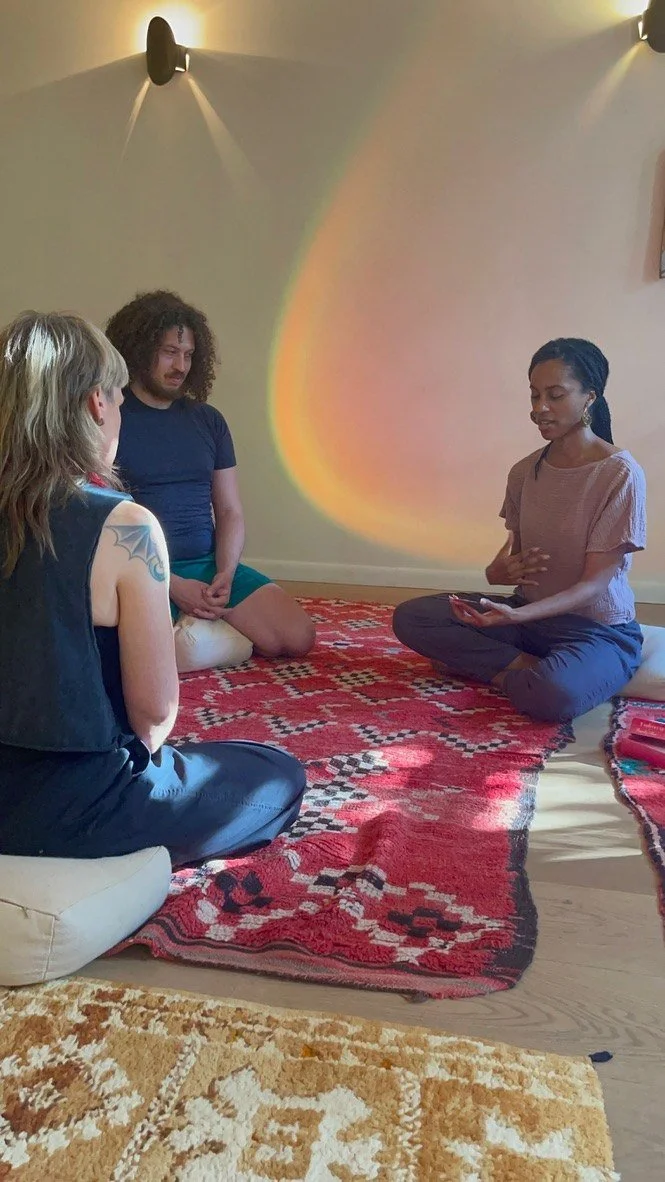
Through guided somatic meditation, movement, witnessing, and archetypal card pulls, we will create space to listen to the body and discover what happens when we allow ourselves to move without having to perform, produce, explain, or get it right.
There is no external influence of being told how to move. You tune in and listen through presence. This is what makes Authentic Movement so special. If you feel fear when reading this, it might be because your body knows it's special. We will dim the lights and move by candlelight. It's a gorgeous way to live.
We will ask ourselves: how present can we become in this very moment — to our skin, our bones, our breath, and the inner impulse of the body? What is the quality of that presence? Can we trust the language and impulse of the body to lead us somewhere new, or bring an old unfinished experience into a new relationship?
There is no prescribed movement and no particular experience we are trying to have. We might pulse or thrash to our own heartbeat. We might linger in hesitation or uncertainty. We might approach or move away. We might play with our yes and our no. We might discover pleasure, stillness, bravery, or shyness. We may even find ourselves in a state we have never known before — ecstatic, deeply quiet, or touching something unnameable and spiritual.
We practice noticing
Questions for the body
- How does my body wish to move?
- Can I wait for an impulse rather than force one?
- Where do I contract? Where do I expand?
- What happens when I take up more space?
- Can I stay with myself while another person is present?
- Can I let myself be seen without abandoning myself?
- What happens if I say no or yes?
Witnessing
Half moving, half witnessing
Half of this practice is moving. The other half is witnessing. Through witnessing, we practice being in relationship with another person in a way that allows them to remain separate, to be in process, and, at times, to arrive. We practice being deeply present without taking responsibility for another person's experience — without fixing, interpreting, rescuing, or merging.
Instead, we offer the quality of our attention. I am here. I see you. I do not need to change your experience in order to be with you. I trust your movement is leading you where you need to go. This is relational presence.
Can I care for you without taking you over? Can I remain connected to myself while staying present with you? Can I allow you to be separate from me and care for myself in that experience?
Presence with distinction
How we inhabit our lives
The practice is not only about how we move in the room. It is about how we learn to inhabit our lives. For some, this may mean learning to live bigger — to take up space, express desire, risk visibility, and allow more pleasure. For others, it may mean learning to live quieter — to slow down, listen more deeply, and discover the power of stillness. It may mean learning to stay when we would normally flee, or learning to leave when we would normally abandon ourselves. We are listening for the impulses to guide.
This practice can travel into our intimate relationships, our work, our creativity, our sexuality and pleasure, our friendships, our conflicts, our celebrations, our communities, and the ways we move through the world.
Truly knowing ourselves requires space to move. The body is not simply something we carry through our lives. The body is where we live them.
Join Body as Beloved
Next gathering: Tuesday, December 1 · 6:30–8:30 pm
Maha Rose, 200 Columbia Street, Brooklyn, NY 11231 · $75
Registration is through Maha Rose.